Should you appeal your 2027 Philadelphia assessment?
A free, honest verdict using the city's own public records — in about ten seconds.
⏱ First Level Review deadline: September 1, 2026 · Formal BRT appeal: October 5, 2026
The verdict is free. No sign-up, no email required.
Optional — we'll email it to you now, plus a reminder before the filing deadline. Nothing else: no list, no spam.
How the City set your 2027 number
Not with an appraisal. Philadelphia values more than 580,000 properties at once using a statistical model — in the City's own words, "individual analyses and appraisals of properties are not practical for ad valorem (at value) tax purposes."
Your assessment starts from a base value for a typical home in your Geographic Market Area, then multiplies up or down for style, square footage, era built, lot size, garage, and condition. Homes that never sold are valued the same way. Nobody visited your house, and nobody looked at your specific sale.
The City grades that model on citywide averages, and by those measures the 2027 revaluation performed well — its independent review found a median assessed-value-to-sale-price ratio of 0.99 and a dispersion measure of 10%.
Read that second number again. A 10% dispersion means the typical home's value sits about 10% away from the citywide midpoint — some high, some low. That is a good score. It is also the City reporting, in its own statistics, that individual homes routinely land 10% or more off the mark.
Sources: Office of Property Assessment, Tax Year 2027 Mass Appraisal Valuation Methodology Overview (June 2026); Independent Ratio Study Report — City of Philadelphia, Keene Mass Appraisal Consulting (June 2026). Both published at phila.gov.
What we analyze before you spend a dollar
The city's own records
Every fact comes from Philadelphia's Office of Property Assessment public data:
- Your assessment history, year by year
- Your home's recorded characteristics — size, age, condition rating
- Deed sale history for your property
- Exemptions & abatements on your account
The test the City uses
There is one recognized way to score an assessment: against real sale prices. The City's own reviewer applies that test citywide. We apply the same test to your block:
- Every recent arm's-length sale near your home
- Similar size, vintage, and city condition rating
- Priced per square foot against your assessment
- Sold within the last 12 months, so the comparison needs no adjusting
What we screen out
Bad comps are how weak appeals die. We exclude:
- Tax-abated sales (prices inflated by the tax break)
- Sales priced far below the surrounding market — which is what nominal transfers and distress deeds look like in the data
- New-construction premiums
- Homes we can't defensibly compare to yours
Simple, flat launch pricing
The verdict
Fight or don't-file, how many real sales back it, the map, and the homestead-exemption check. No sign-up, no email, no catch.
Evidence package
The complete ready-to-file case for your property. One-time. No contingency percentage, no subscription, ever.
Smaller cases
When projected savings are under $500/year, the package costs less — automatically. Same evidence, fair price for the stakes.
Philadelphia reassesses every two years — most recently for 2023, 2025, and 2027. Buyers who win and share their decision letter get the next reassessment's evidence check at a loyalty discount if the City raises their value again.
What's in your evidence package
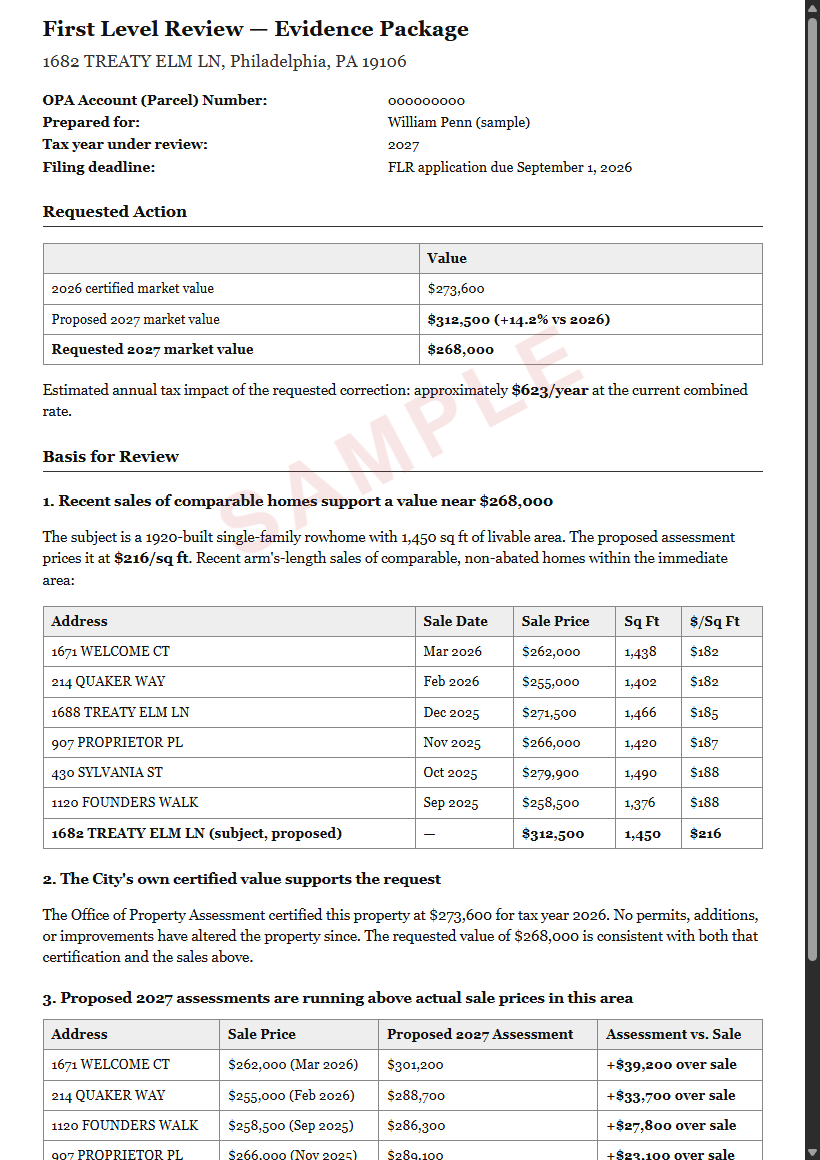
- Your requested value — the number to ask for, with the annual tax savings it's worth
- Comparable-sales exhibit — the strongest recent sales supporting your case, in the table format reviewers expect
- The over-assessment pattern — neighbors assessed above what their homes actually sold for, all within the last 12 months so no time adjustment is needed, straight from city records
- High sales, pre-answered — the expensive nearby sales a reviewer might cite, distinguished on the record (abatements, newer construction, condition)
- Line-by-line form instructions — which box to check, the exact Land + Improvement = Total split the form requires, where to mail it
- Both deadlines covered — the same evidence packet can be used whether you file the September FLR or the October BRT appeal
Print it, sign the one-page city form, attach the exhibit, mail it. You file it yourself — we never represent you, which keeps you in control and keeps our launch-season price at $49 (regularly $79) instead of a contingency firm's 25%+ of your savings.
Why you can trust the verdict
Graded the same way the City is
There is one recognized measure of assessment accuracy: assessed value against actual sale prices. It's how the City's own independent reviewer scored the 2027 revaluation, and it's the test our model has to pass in your neighborhood before we'll make any claim about your home. Where it can't pass, we say "manual review" instead of guessing.
Honest by design
Most checks end with "you're fine — don't file," backed by the count of real sales behind the verdict. And if your account is missing the City's free homestead exemption (~$1,399/year), we tell you that too — free, with instructions. A tool that flags everyone helps no one.
Every number sourced
Nothing in your report is estimated by a human or invented by AI — every figure traces to a City of Philadelphia public record you (or a reviewer) can look up.
Common questions
Could filing make my assessment go up?
A First Level Review can result in a decrease, no change, or an increase. That's exactly why we only recommend filing when the sales evidence runs clearly in your favor — and tell you "don't file" when it doesn't.
How does it work, start to finish?
Type your address and get the free verdict in seconds. If it says "worth fighting," the evidence package generates instantly after checkout — print it, sign the one-page FLR form that came with your Notice of Valuation, attach the exhibit pages, and mail it (postmarked by September 1). The City typically mails decisions in the fall. Total effort on your end: a printer, a signature, and a stamp. And when your decision letter arrives, send us a copy — winners get a loyalty discount at the next reassessment if the City raises their value again.
What counts as an "arm's-length" sale?
A sale on the open market between unrelated parties, with neither side under pressure — in other words, the price a willing buyer actually paid a willing seller. Those are the only prices that reflect true market value, so they're the only ones our verdicts are built on. Because the City's public records don't label how a sale was arranged, we screen on price rather than paperwork: sales below a hard dollar floor are dropped, and so is any sale priced far under the surrounding market. That's what $1 deeds, nominal transfers, and distress sales look like in the data — but a family transfer or sheriff sale priced close to market can look ordinary, and we'd rather tell you that than claim a certainty we don't have.
Is this legal or tax advice?
No. It's an informational report built from public records. You file your own review; no one represents you. Many owners handle an FLR entirely on their own — the form is one page.
Do you cover condos, multi-family, or commercial properties?
Right now the automated verdict covers single-family homes and rowhouses — that's where our model is validated against real sales, and we won't guess where it isn't. Condos, multi-family, and commercial properties show "manual review needed." If that's you, email hello@benchmarkappeal.com and we'll take a look.
I have a tax abatement — should I still appeal?
Maybe not, and we check this automatically. If your building value is abated, a scary-looking assessment increase may cost you little or nothing until the abatement expires — and filing an appeal can invite attention your tax bill doesn't need. Your free verdict accounts for the abatement and says so plainly.
I own several properties — can you check them all?
Yes. Run any address free, one at a time — or for portfolios, email hello@benchmarkappeal.com and we'll run a batch check with portfolio pricing. We'll also tell you which of your properties are not worth appealing, which is half the value of the exercise.
What if my report can't be generated?
You won't be charged. We check that we can build a full-quality package for your property before checkout, and if the evidence is too thin, we say so.
What if my assessment is fair but I'm overpaying anyway?
A third of owner-occupied Philadelphia homes appear to be missing the City's free homestead exemption — worth about $1,399 every year. Your free verdict includes that check automatically. If you're missing it, we show you how to claim it (free, ~10 minutes, no service required).
What happens if my appeal loses?
Usually nothing changes — the City denies the request and your assessment stays where it was. You're out the price of the packet, not more, and you keep two paths: the formal Board of Revision of Taxes appeal (deadline October 5) if you want a second look this year, and the next citywide reassessment, which is a fresh appealable event — Philadelphia reassesses every two years, so the next one is expected for tax year 2029. If you bought a package and take your case to the BRT, your evidence still stands — email us and we'll send updated filing instructions at no charge. One note: the BRT holds a short hearing; individual owners can represent themselves, but properties owned by an LLC or corporation generally need an attorney to appear. It's also why we gate hard on evidence — most denials happen when the comps are thin, and if yours are, we'll have told you "don't file" before you spent a dollar.
Why is the deadline urgent?
The FLR must be postmarked by September 1, 2026. Miss it, and your only path is the formal Board of Revision of Taxes appeal by October 5 — a longer process with a hearing.
Informational report only — not legal, tax, appraisal, or assessment advice. Benchmark does not appraise or assess property; only the City's Office of Property Assessment assesses property in Philadelphia. Data: City of Philadelphia Office of Property Assessment public records; verify against your mailed Notice of Valuation. Potential savings are estimates, not guarantees; outcomes are determined by the OPA and the Board of Revision of Taxes. Benchmark is operated by Benchmark Appeal LLC, a private service not affiliated with the City of Philadelphia. Terms, Privacy & Refunds